© Kam Hoo Man
Yuen Long, Hong Kong, China
Latitude: 22° 26' 40'' N
Longitude: 114° 1' 20'' E
17 June 2015 1906 (Local Time)
Image P/S code: S.13.11.4.2
Image I.D.: 4904
-

Crepuscular rays cast by Cumulus congestus
Although the term “Crepuscular rays” normally refers to dark bluish streaks and light beams observed radiating from the Sun across the twilight sky, the name is also used to refer to the shadowed bands and light beams which diverge from the Sun at any time of day when it is hidden behind cloud (usually Cumulus or Cumulonimbus).
In this photograph from Hong Kong (China), crepuscular rays are cast across the sky by Cumulus congestus clouds. The lines accentuating these cloud shadows and bright sunbeams are actually parallel, but appear to radiate from the position of the Sun, located behind the cloud.
An accessory cloud known as pileus can be seen above one of the rising Cumulus congestus towers.
Links in the image description will highlight features on the image. Mouse over the features for more detail.
© Kam Hoo ManYuen Long, Hong Kong, ChinaLatitude: 22° 26' 40'' NLongitude: 114° 1' 20'' E17 June 2015 1906 (Local Time)Image P/S code: S.13.11.4.2Image I.D.: 4904 © The Government of the Hong Kong Special Administrative Region
Crepuscular rays
Although the term “Crepuscular rays” normally refers to dark bluish streaks and light beams observed radiating from the Sun across the twilight sky, the name is also used to refer to the shadowed bands and light beams which diverge from the Sun when it is hidden behind cloud (usually Cumulus or Cumulonimbus) at any time of day. Sunbeams penetrating through gaps in a layer of cloud and rendered visible by water or dust particles in the air may also be referred to as crepuscular rays.
The most striking feature in this photograph, taken during a summer evening at Wokingham, UK, is the appearance of the bluish shadows cast across the sunlit sky by a large Cumulus congestus cloud. The lines accentuating these shadows and the bright sunbeams are actually parallel, but appear to radiate from the position of the Sun, which is located behind the cloud.
Cumulus congestus and Cumulonimbus clouds formed during the early evening as a result of daytime maximum temperature and low-level convergence caused by the inland penetration of a sea breeze. Thunder was heard later in the evening.
Links in the image description will highlight features on the image. Mouse over the features for more detail.
© George AndersonWokingham, England, United Kingdom of Great Britain and Northern IrelandLatitude: 51° 25' 4'' NLongitude: 0° 51' 48'' W17 July 2013 1727 (Local Time)Camera direction: towards WImage P/S code: P.13.11.4.2Image I.D.: 4071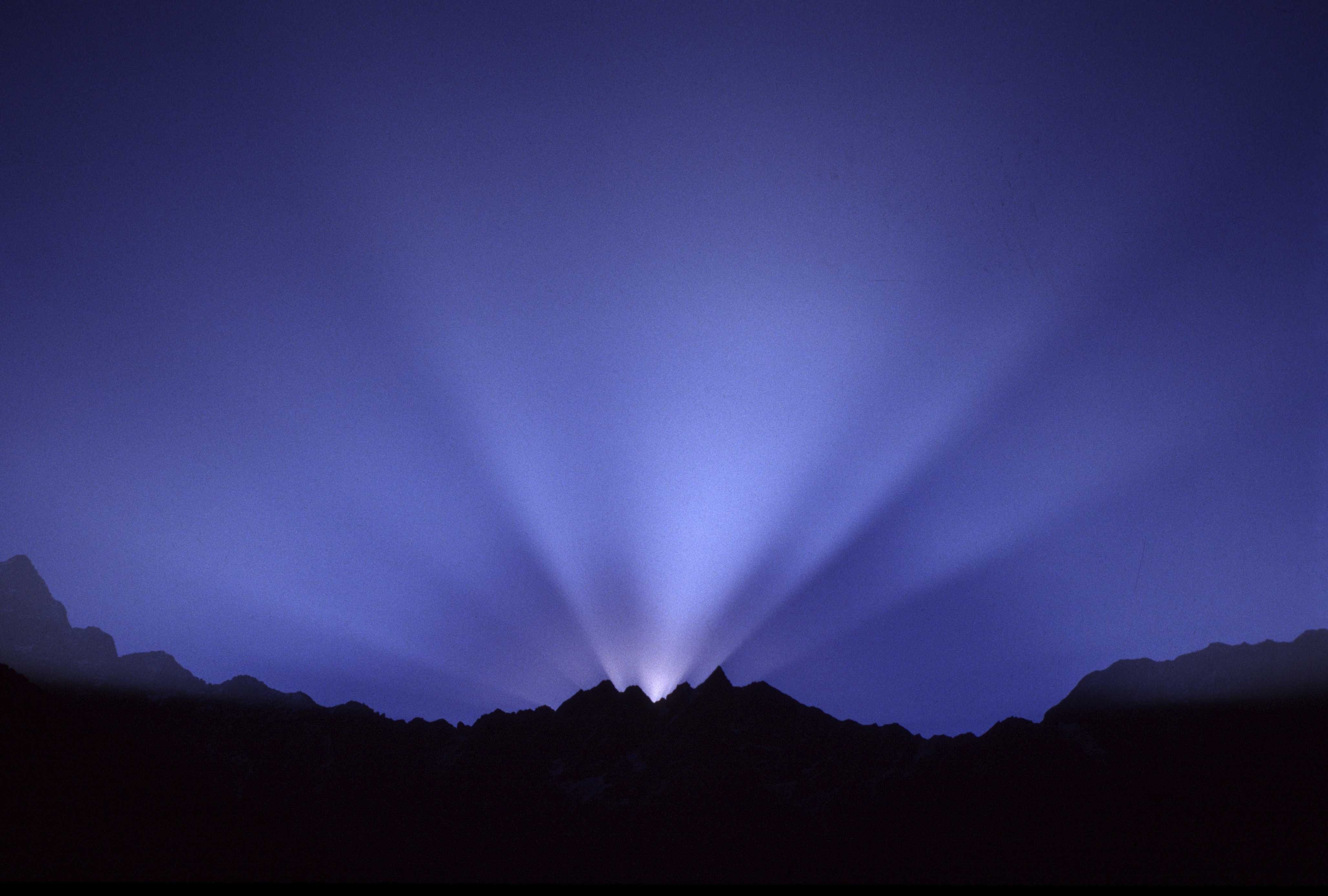
Crepuscular rays
Sometimes dark bluish streaks and light beams are observed radiating from the Sun across the twilight sky. These are crepuscular rays.
In this photograph from Lukla in Nepal, crepuscular rays appear to radiate across the twilight sky from the Sun, hidden behind the Himalayan peaks of Kangtega (6 783 m) and Thamserku (6 623 m). The darker streaks are the shadows of distant clouds or mountains, while the sunbeams shine through gaps in distant clouds or between mountain peaks. The rays are in fact parallel, and their apparent convergence is an effect of perspective in the same way that railway lines seem to converge at a point in the distance.
Links in the image description will highlight features on the image. Mouse over the features for more detail.
© Claudia HinzLukla, Solukhumbu District, NepalLatitude: 27° 41' 16'' NLongitude: 86° 43' 53'' E01 November 1999 0600 (Local Time)Image P/S code: P.13.11.4Image I.D.: 4099