© Stephen Burt
Stratfield Mortimer, near Reading, England, United Kingdom of Great Britain and Northern Ireland
Latitude: 51° 22' 12'' N
Longitude: 1° 2' 24'' W
26 June 2007 1908 (Local Time)
Camera direction: towards W
Image P/S code: S.4.16
Image I.D.: 4957
CL = 0, CM = 3, CH = 1
-
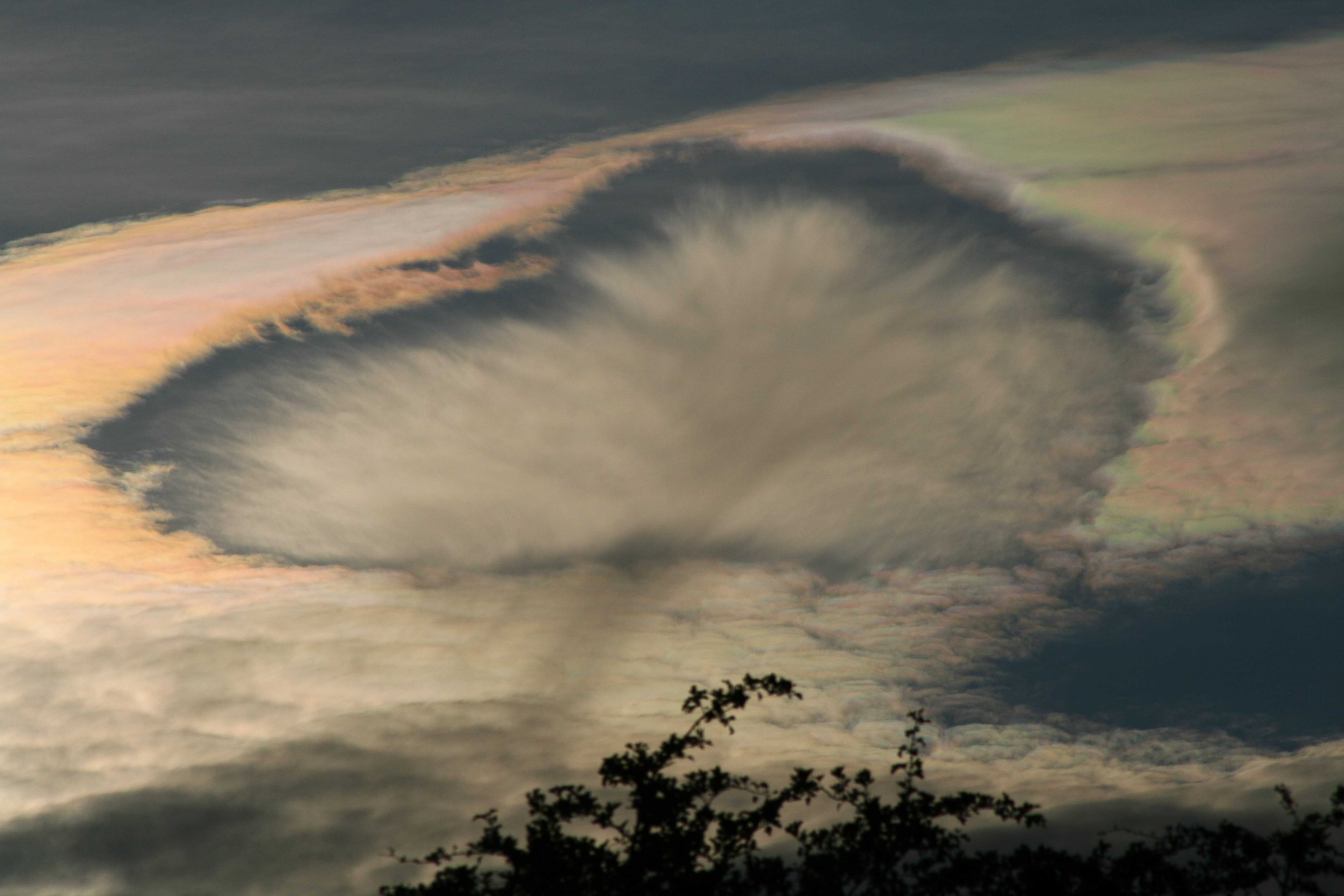
Altocumulus stratiformis translucidus cavum
This image shows a well-developed fallstreak hole in Altocumulus stratiformis. The hole (cavum), filled with ice crystals, formed over a period of 40 minutes and eventually became very large (40° angle of view) as it was blown from the north-west to the south-east. Note that the image has been slightly underexposed deliberately in order to show the irisation or iridescence on the cloud edges, in contrast to which the (ice crystal) virga, or fallstreaks, show as pale grey in colour. An older hole, in which the fallstreaks appear to have evaporated, can be seen at the lower right. Another layer of cloud (duplicatus) can be seen at the lower left of the image. Some higher Cirrus is at the top left.
The Altocumulus formed ahead of a warm front advancing from the north-west around a very deep (for mid-summer – 985 hPa) cyclonic centre located over Denmark, in a cool north-westerly airstream.
The supplementary feature cavum is formed when glaciation occurs in a thin cloud layer consisting of supercooled water droplets in a liquid state at a temperature below 0 °C. As the supercooled water drops glaciate, the resulting ice crystals fall from the cloud layer to a lower level as virga, or fallstreaks. The resulting cloud hole typically grows larger with time as the glaciation process continues. The ice crystals may fall into drier air, where they evaporate, and so the hole may eventually lose its central fallstreaks.
Links in the image description will highlight features on the image. Mouse over the features for more detail.
© Stephen BurtStratfield Mortimer, near Reading, England, United Kingdom of Great Britain and Northern IrelandLatitude: 51° 22' 12'' NLongitude: 1° 2' 24'' W26 June 2007 1908 (Local Time)Camera direction: towards WCL = 0, CM = 3, CH = 1Image P/S code: S.4.16Image I.D.: 4957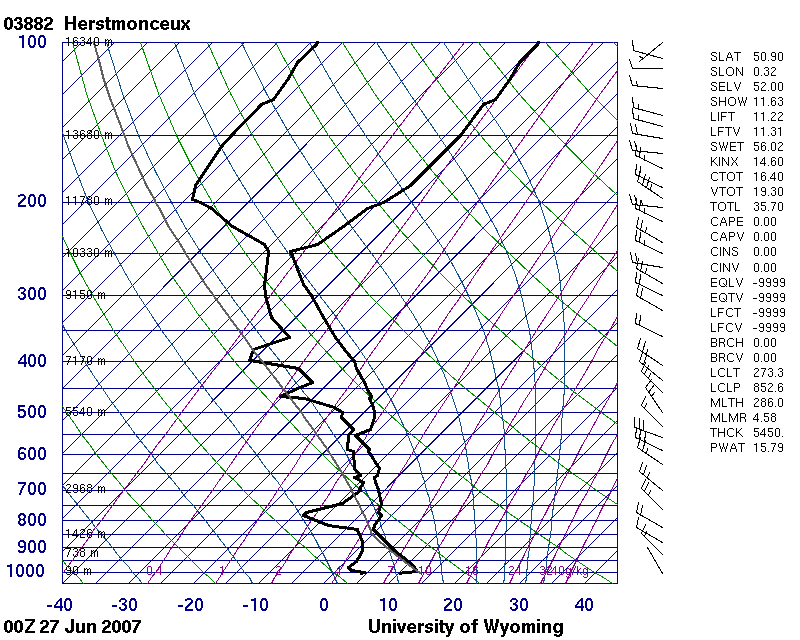 This sounding is from Herstmonceux, England, UK (WMO 03882), 110 km south-east of Stratfield Mortimer, 6 hours later. The Altocumulus layer is probably at 550 hPa, suggesting that the supercooled cloud droplets would have been at a temperature of around –18 °C.© University of Wyoming
Altocumulus stratiformis perlucidus translucidus cavum
This thin, translucent and extensive layer of cloud is Altocumulus stratiformis translucidus. In the top part of the picture it also displays the variety perlucidus, as there are the gaps between the cloud elements. However, the most striking feature is the large, roughly circular hole beneath which there is virga. The large hole is the supplementary feature cavum, popularly known as a “fallstreak hole” or “hole-punch cloud”. The full classification for the cloud is therefore Altocumulus stratiformis perlucidus translucidus cavum.
Also of note is a linear gap in the cloud between the fallstreak hole and the horizon. This is an aircraft dissipation trail, or distrail, formed as a result of an aircraft flying through the cloud layer. Informally this is sometimes known as a “canal cloud”. It later transformed into a circular-type hole (see the accompanying time lapse).
The supplementary feature cavum is formed when glaciation occurs in a thin cloud layer consisting of supercooled water droplets that are in a liquid state and at a temperature below 0 °C. As the supercooled water drops glaciate, the resulting ice crystals fall from the cloud layer to a lower level as virga, or fallstreaks. The resulting cloud hole typically grows larger with time while the glaciation process continues.
Links in the image description will highlight features on the image. Mouse over the features for more detail.
© Tsz Cheung LeeKwun Tong, Hong Kong, ChinaLatitude: 22° 18' 41'' NLongitude: 114° 13' 38'' E19 January 2015 0830 (Local Time)Camera direction: towards SWCL = 0, CM = 3, CH = 0Image P/S code: P.4.16Image I.D.: 5167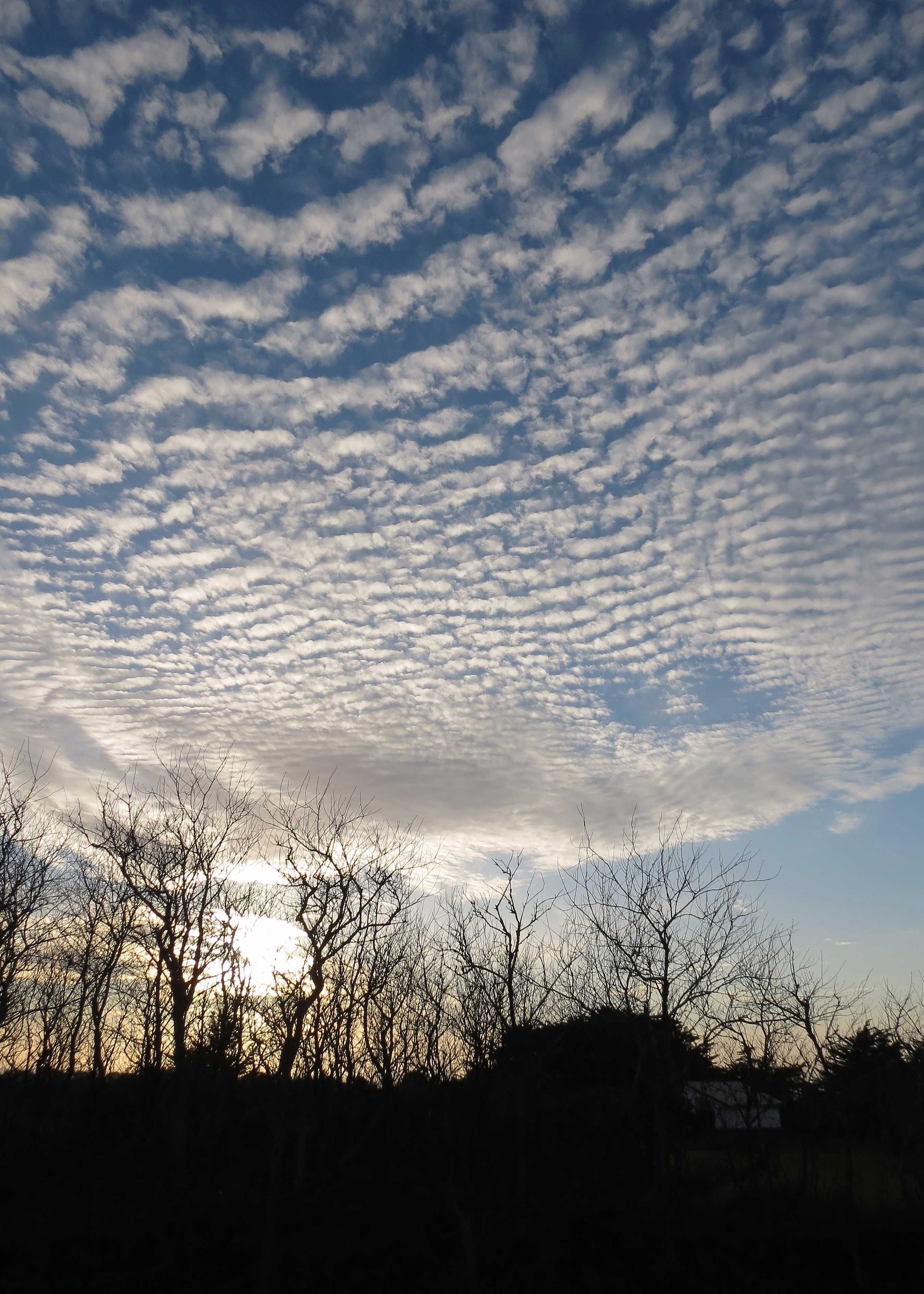
Altocumulus stratiformus translucidus
The cloud is an extensive thin sheet (species stratiformis) with merged cloud elements arranged in broadly parallel lines (variety undulatus). The sky is easily visible through the layer, identifying the variety translucidus. The blue of the sky can also be seen in the spaces between the lines of merged elements (variety perlucidus). The colour is predominantly white, with some light grey colouration near the back edge due to the cloud being thicker and to the low angle of the Sun.
Links in the image description will highlight features on the image. Mouse over the features for more detail.
© Frank Le BlancqLa Pulente, St Brelade, JerseyLatitude: 49° 11' 18'' NLongitude: 2° 13' 33'' W25 November 2012 1626 (Local Time)Camera direction: towards SWCL = 0, CM = 3, CH = 0Image P/S code: P.4.1Image I.D.: 5479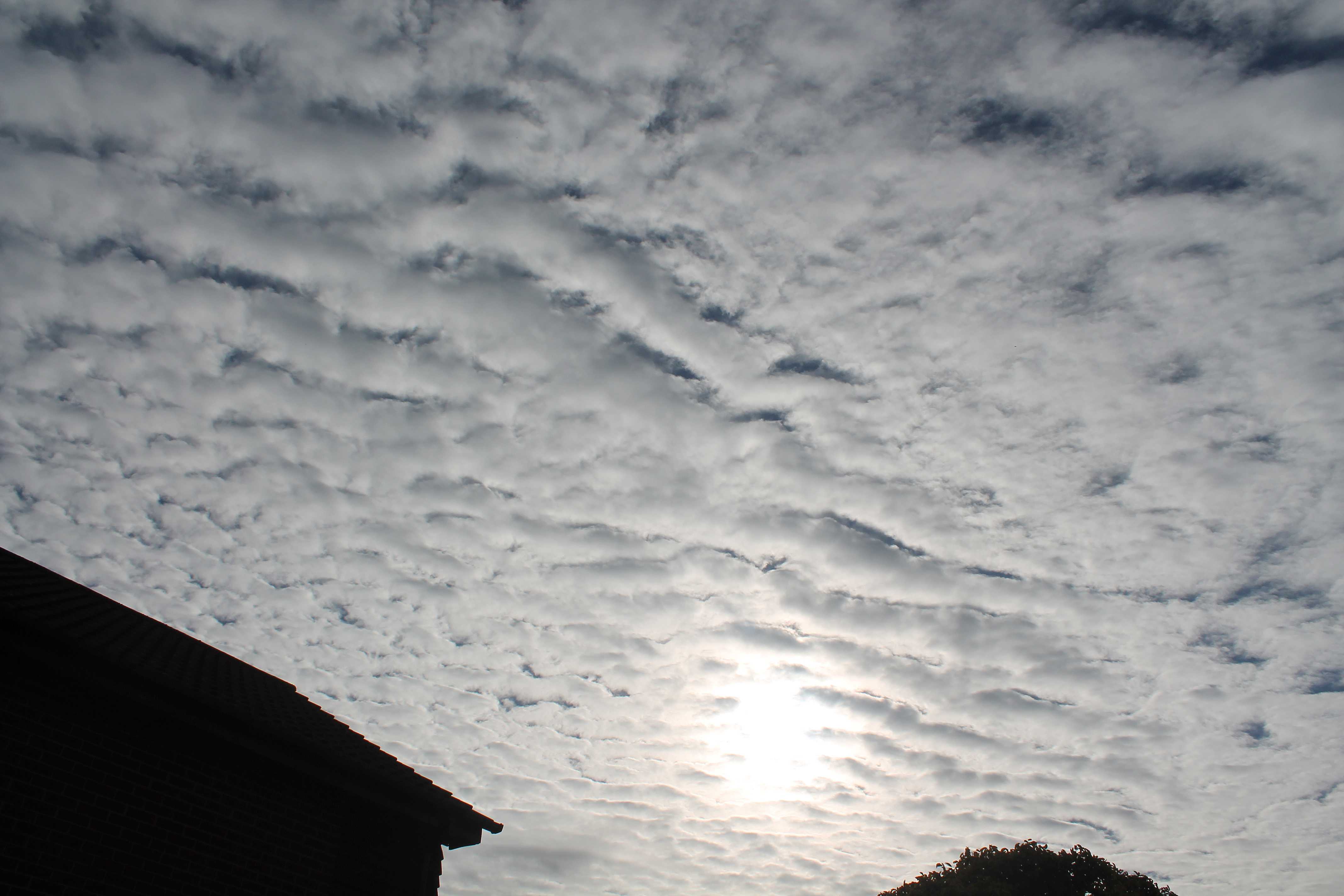
Altocumulus stratiformis translucidus perlucidus undulatus
This layer of medium-level cloud is Altocumulus. Its rounded masses and rolls have an apparent width of between 1° and 5° and there is some shading. The specific species of this Altocumulus is classified as stratiformis, due to the cloud’s extensive coverage of the sky. The sheet of cloud is sufficiently translucent to reveal the position of the Sun, and so it is also of the variety translucidus. In places there are spaces between the cloud elements, which also indicates the variety perlucidus, and the enlongated and broadly parallel rolls indicate that the variety undulatus also applies.
Links in the image description will highlight features on the image. Mouse over the features for more detail.
© George AndersonWokingham, England, United Kingdom of Great Britain and Northern IrelandLatitude: 51° 25' 36'' NLongitude: 0° 49' 26'' W31 August 2014 0850 (Local Time)Camera direction: towards SECL = 0, CM = 3, CH = /Image P/S code: P.4.7Image I.D.: 5172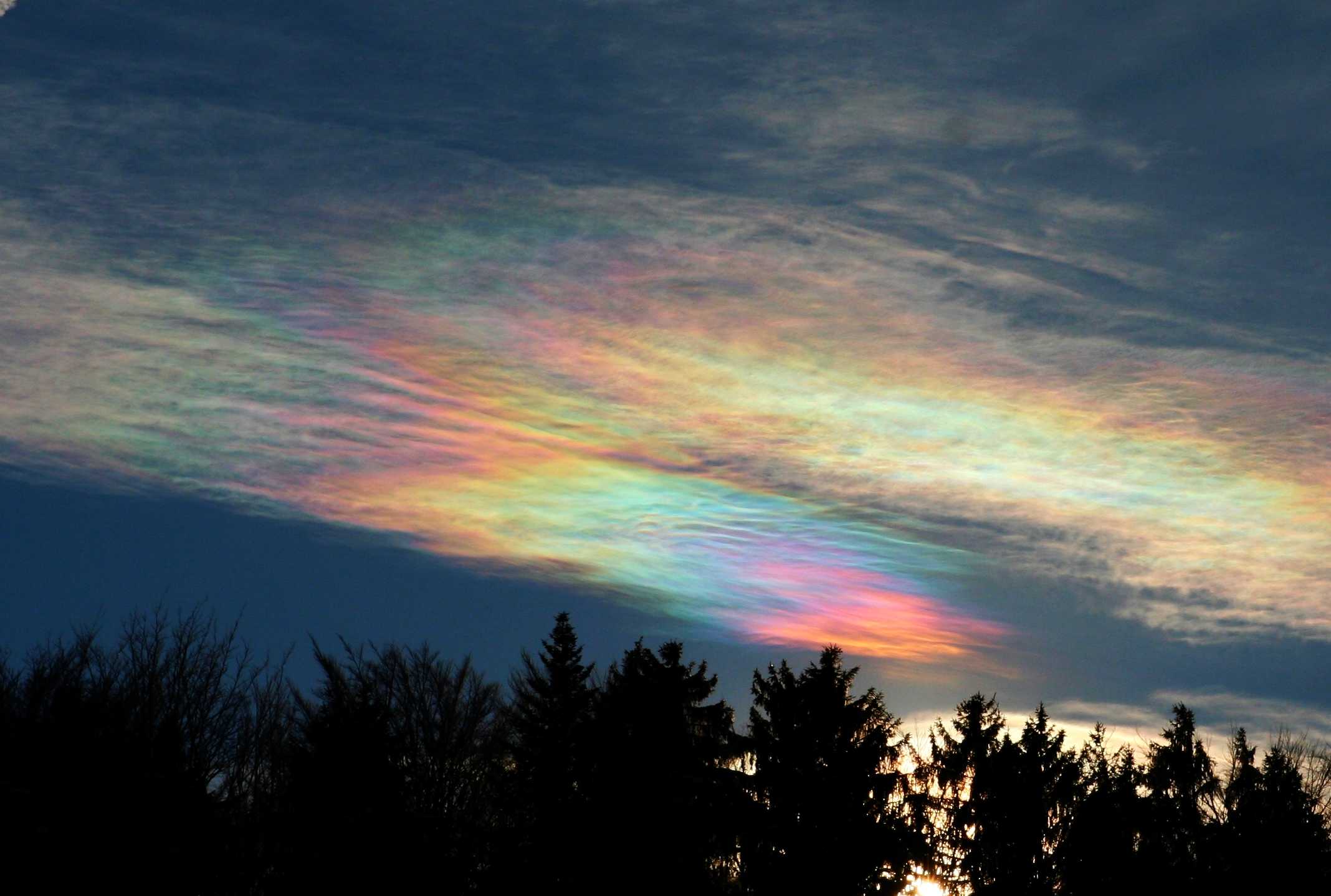
Irisation/iridescence
Iridescent colours cover a large part of this cloud layer. This is known as irisation.
The cloud is identified as a very high Altocumulus, almost bordering on Cirrocumulus. As the layer is relatively extensive, it is of the species stratiformis. It is also thin and translucent (variety translucidus) and there are undulations (variety undulatus).
Irisation results from the interaction of sunlight with small, uniformly sized cloud particles. Within about 10° from the Sun, diffraction is the main cause of irisation. Beyond about 10°, the interference of light waves is usually the predominant factor.
The colours green and pink tend to predominate, although other colours are seen, such as blue. They are often delicate, pastel shades, but can be brilliant.
Links in the image description will highlight features on the image. Mouse over the features for more detail.
© Claudia HinzBrannenburg, GermanyLatitude: 47° 44' 20'' NLongitude: 12° 5' 18'' E31 December 2005 1439 (Local Time)Camera direction: towards SWCL = 0, CM = 3, CH = 0Image P/S code: P.13.3Image I.D.: 5624