© Stijn van Puijvelde
Terneuzen, Netherlands
Latitude: 51° 19' 15'' N
Longitude: 3° 50' 29'' E
10 September 2011 2050 (Local Time)
Image P/S code: S.11.2.9.1
Image I.D.: 5465
-

Large hailstones
Hail is a precipitation of particles of ice. Hailstones can be either transparent, or partly or completely opaque. They are generally between 5 and 50 mm in diameter, and although usually spheroidal in shape, they can be somewhat irregular in form. Such irregular lumps are formed by the sticking together of smaller hailstones while still in the cloud, which is clearly indicated here by the knobbly or lumpy appearance. The internal structure of the stones clearly suggest that these large hailstones have formed as a result of the agglomeration of smaller stones.
Links in the image description will highlight features on the image. Mouse over the features for more detail.
© Stijn van PuijveldeTerneuzen, NetherlandsLatitude: 51° 19' 15'' NLongitude: 3° 50' 29'' E10 September 2011 2050 (Local Time)Image P/S code: S.11.2.9.1Image I.D.: 5465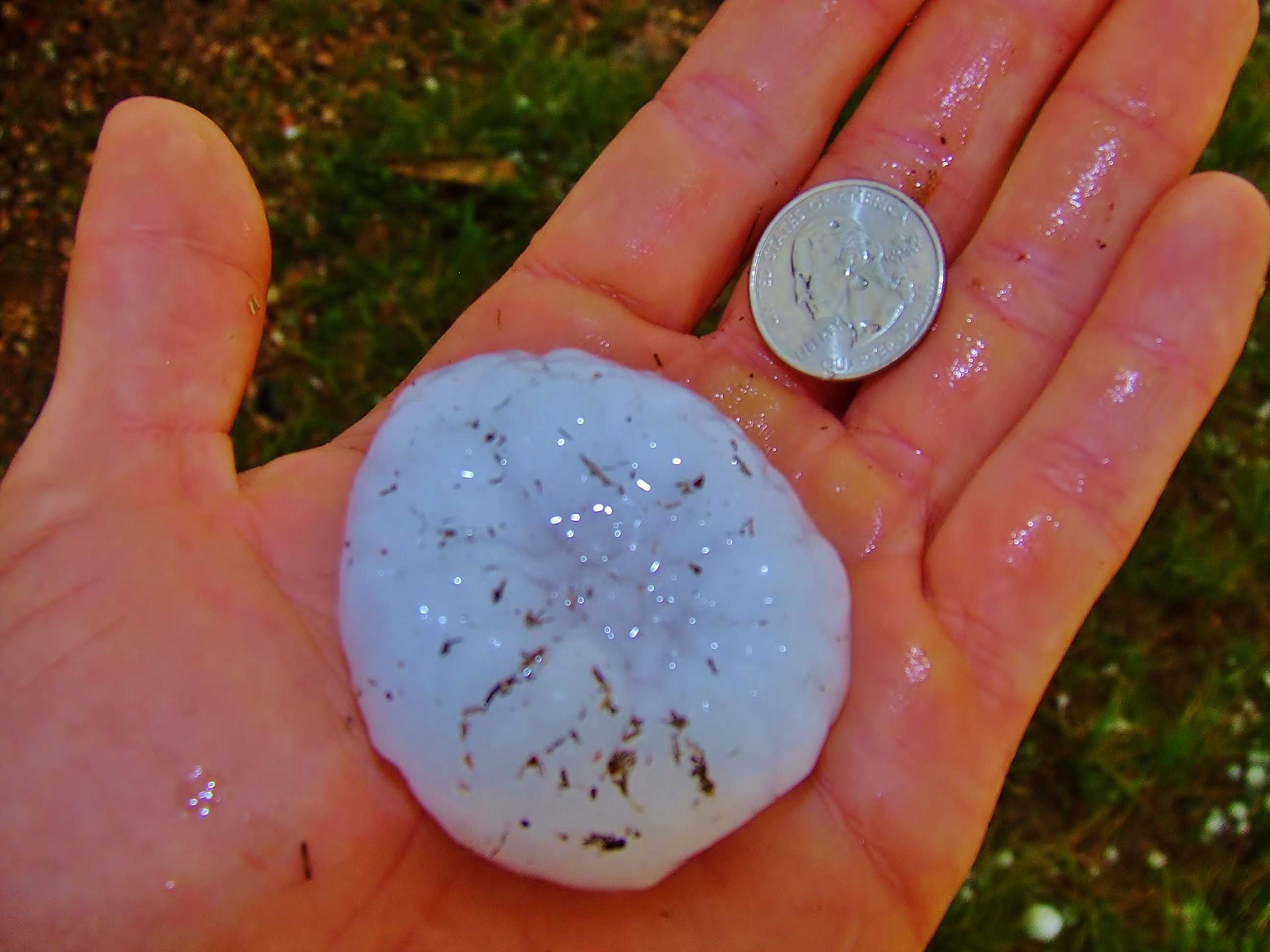
Large hail
This picture shows a tennis ball-sized hailstone that fell from a tornadic supercell in south-eastern Wyoming, USA. The diameter of the stone is over 6 cm. Its size can be compared against an American quarter, which has a diameter of 2.43 cm.
Hailstones can occur in a variety of sizes, even within a single fall. This was one of the larger stones in this fall; the median diameter of all of the hailstones was closer to golf ball-size.
The internal structure of this hailstone suggests that it formed as a result of smaller stones sticking together within the cloud before falling to the ground.
Links in the image description will highlight features on the image. Mouse over the features for more detail.
© Eric Van LochemBurns, Wyoming, United States of AmericaLatitude: 41° 11' 34'' NLongitude: 104° 21' 33'' W07 June 2012 2030 (Local Time)Image P/S code: P.11.2.9.1Image I.D.: 5553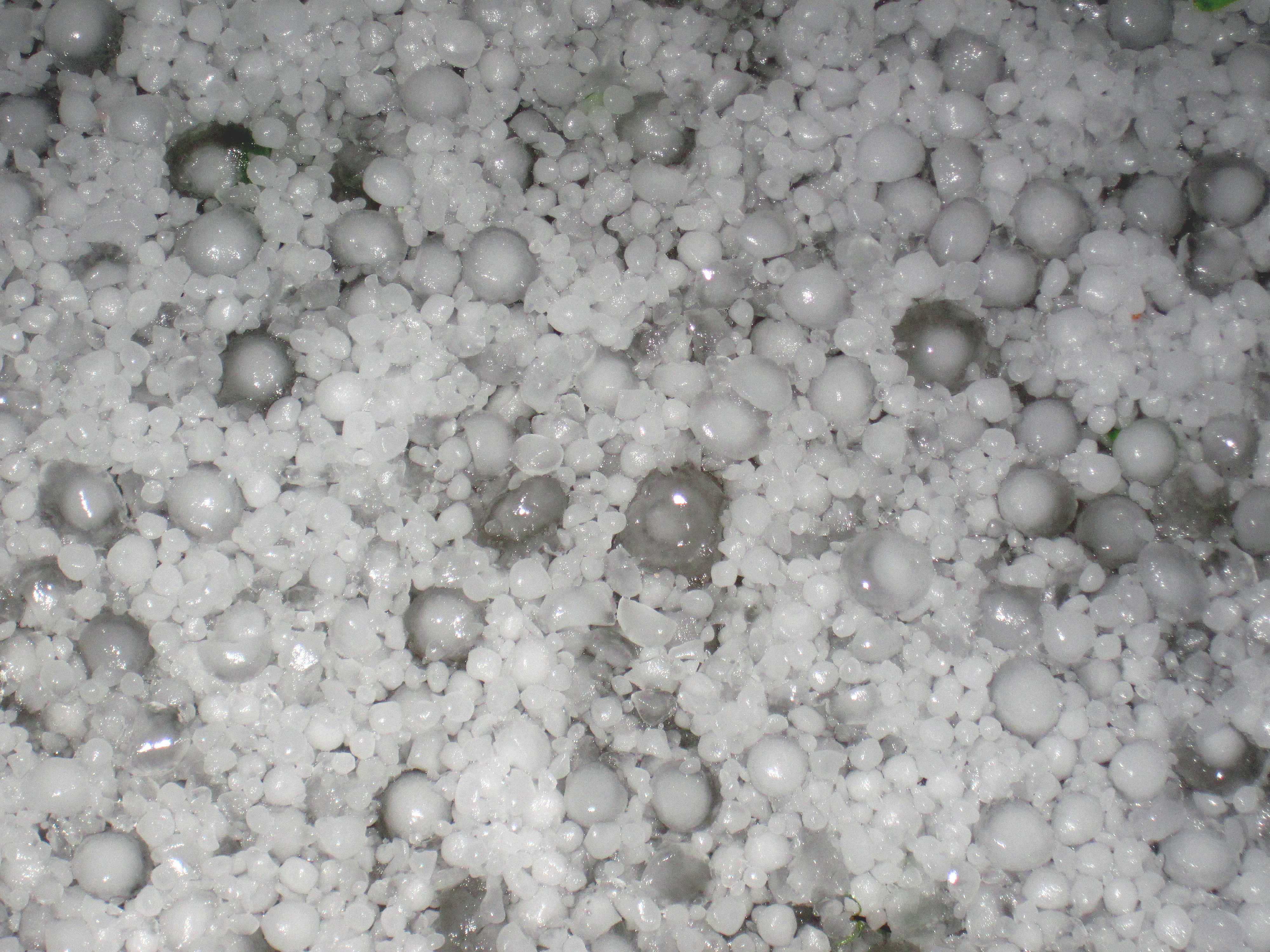
Hail
These hailstones fell from a relatively small but intense convective storm cell which moved over the small town of Limon, Colorado, USA. During the event, the size of the hailstones changed over time, resulting in the size distribution shown in this photograph. The smaller hailstones in the picture are over 5 mm in diameter, while the largest are around 15 mm to 25 mm across.
Hailstones are particles of ice which can be either transparent, or partly or completely opaque. They are usually spheroidal, conical or irregular in form. In this photograph, most of the hailstones are spherical.
Falls of hail occur as showers from Cumulonimbus clouds, usually during thunderstorms. Hailstones usually form around a nucleus which may be anywhere from a few millimetres to one centimetre in diameter. The nucleus, composed of ice that is usually opaque, may be surrounded by alternating layers of transparent and opaque ice. In this picture the larger hailstones clearly show opaque ice at their centres, surrounded by a layer of transparent ice.
Links in the image description will highlight features on the image. Mouse over the features for more detail.
© James St. JohnLimon, Colorado, United States of AmericaLatitude: 39° 16' 11'' NLongitude: 103° 42' 34'' W04 July 2010 2237 (Local Time)Image P/S code: P.11.2.9Image I.D.: 3871